




How to Stop Overthinking at Night
It usually happens when the rest of the world quiets down, you’ve turned off the lights, settled into your pillow, tucked under your blankets, and set aside to sleep. But instead of going into peaceful rest, your brain turns on the light switch.
Suddenly, your mind becomes a buzzing amphitheater of relentless thoughts. You replay an embarrassing sentence you said three years ago. You analyze tomorrow’s workload step by meticulous step. You ponder hypothetical scenarios that haven’t happened and likely never will.
You watch the numbers on your bedside clock tick upward—12:30 AM, 1:45 AM, 3:15 AM—and with every passing hour, a creeping panic sets in: If I don’t fall asleep right now, tomorrow is going to be ruined.
If this scenario sounds intimately familiar, you are not broken, and you are certainly not alone. Nighttime rumination is one of the most common human experiences, yet knowing that doesn’t make it any less exhausting.
Learning how to stop overthinking at night isn’t about forcing your brain to go completely blank—it is about understanding why your mind chooses bedtime to throw a party, and giving yourself gentle, practical tools to step off the emotional carousel.
Why Your Brain Chooses Bedtime to Panic and How to Stop Overthinking at Night
To solve a problem, it helps to understand why it occurs in the first place. Why does a brain that functioned reasonably well all day suddenly go into overdrive the second your head touches the pillow?
During daylight hours, your focus is distributed across dozens of external inputs. You are responding to messages, navigating conversations, commuting, cooking, organizing, and consuming digital media. Your attention is continuously pulled outward.
When you lie down in the dark, all those external distractions vanish instantly. The noise dies down, the screen goes dark, and for the first time in sixteen hours, you are left in complete silence with your internal thoughts.
Your brain treats this sudden drop in external noise as an invitation to process every piece of backlogged emotion, unmade decision, and unresolved stress accumulated throughout the day.
Add to this our natural evolutionary biology. When we are fatigued, our prefrontal cortex—the logical, reasonable part of the brain responsible for emotional regulation—goes offline to rest. Meanwhile, the amygdala—the brain’s alarm system—remains vigilant.
Without the prefrontal cortex around to say, “Hey, that mistake from 2019 really doesn’t matter right now,” the amygdala takes the reins, magnifying small worries into catastrophic crises.
The Evening Ramp-Down: Preventing the Brain Dump

Most people expect to move at a hundred miles an hour all day, hop into bed, and immediately power off like a smartphone. But the human mind is closer to a heavy freight train than an electronic switch: it needs time and track to slow down before coming to a full stop.
If you want to master how to stop overthinking at night, your strategy must start long before you actually turn off the light.
1. Create a “Brain Dump” Buffer Hour
Instead of letting your bed become the place where you sort through your worries, create a dedicated space for that processing earlier in the evening. About one to two hours before you plan to sleep, sit down with a physical notebook and a pen in a comfortable, lit room.
Set a ten-minute timer. Then write down a list of everything overblown in your head:
- All your tasks that need to get done in the next day
- Unanswered emails that weigh on you
- Anxieties, no matter how vague, about what is going to happen
- The things that upset you today
When you get rid of your thoughts by writing them down, you are telling your subconscious: Everything is safe. I don’t need to go over it again to remember it.
2. Set an “Anxiety Appointment”
It sounds counterintuitive, but if chronic worries keep popping up at midnight, schedule time for them at 7:00 PM. Permit yourself to worry deliberately for fifteen minutes.
Analyze the problems, write out potential solutions, and then close the notebook. When those same worries try to gain entry to your head at bedtime, you can gently remind yourself: I already addressed this during my worry time, and I will revisit it tomorrow.
3. Establish a Digital Curtain Call we
The blue light from phones, tablets, and laptops suppresses melatonin production, but the content on those screens does far worse damage to an overthinking mind. News updates, social media comparisons, and work communications flood your system with dopamine and cortisol, putting your nervous system on high alert.
Establish a firm cutoff time for screens—ideally 60 minutes before bed. Swap scrolling for low-stimulation activities like reading fiction, taking a warm bath, listening to soft music, or stretching.
LIVE ON THE GROUND: What to Do When You Can’t Stop the Loop

While you do all you can right now, you may still have nights when the thoughts get out of hand. If you find yourself in a cycle that seems to take over during the last hour or more at night, you can try these steps that can be employed now to disrupt the loop.
The 20-Minute Reset Rule do
One of the worst things you do when overthinking is stay in bed tossing, turning, and staring at the clock. When you stay in bed feeling anxious, your brain begins to associate your mattress with frustration and hyper-arousal rather than rest.
If you have been lying awake for roughly twenty minutes and feel your mind accelerating, get out of bed. Keep the lights low and move to another comfortable room. Read a chapter of a soothing book, sip warm herbal tea, or practice calm breathing. Only return to bed when your eyelids feel heavy and physical drowsiness sets in.
- Sensory Grounding
Overthinking is a method of losing yourself in a dream or in a past that has already happened because you are in the habit of thinking, there are practices that bring you back right into this moment right now, and you are in the safety of your bed.
A 5-4-3-2-1 Sensory Method specifically designed for bedtime:
- Recognise the 5 unexplored sensations in your gradual awareness of the world around you (textures of the sheets, the duvet, the pillowcase warming your cheek).
- Validate the four quiet sounds that resonate through the room (a fan whirring, your own breathing at a steady rhythm, distant city traffic).
- Be aware of 3 sensations in your body (your heartbeat, warmth in your toes, relaxed tension or tension in your shoulders).
- Identify 2 subtle scents (clothes like fresh linen, lavender pillow spray).
- Acknowledge your present positive physical sensation.
- Cognitive Shuffle

The cognitive scientist Dr. Luc Beaudoin developed this clever mind trick called the “Cognitive Shuffle”. This tricks your brain into thinking it is already falling asleep.
In the natural process of drifting off, your thoughts are random, in pieces, unconnected and nonsensical. When you overthink, your thoughts are logical and interesting. When you increasingly think random imagery, you evoke the sleep brain and bypass the analytical loops.
THE BEST METHOD OF DOING THIS:
- Select a neutral, random word such as C-A-L-M.
- Attempt to think of as many words starting with C (Let’s say Cat, Candle, Castle, Cloud), and visualize every item vividly for one or two seconds.
- Once you get exhausted with the letter ‘C’, move to the next letter ‘A’ and then to the next, and so on.
- Mostly, people are half asleep before even finishing the word they started.
Reframing Your Self-Talk Around Sleep
q
Much of the distress surrounding late-night overthinking comes from our reaction to the overthinking itself. We get angry at our brains for staying awake, which triggers a fight-or-flight stress response that makes sleep even harder to reach.
By changing your mental language, you take away the pressure:
- From: “A good night’s sleep right now is everything, or tomorrow will be a deal-breaker, I tell my brain, to: “Even if I don’t have the perfect deep sleep on my first night, this quiet resting.
- From: “I just can’t seem to disable my brain like other people can”, to “My brain is simply trying to be protective by processing stress. It is safe now, and these thoughts can wait until morning.
Nurturing a Sleep-Friendly Environment
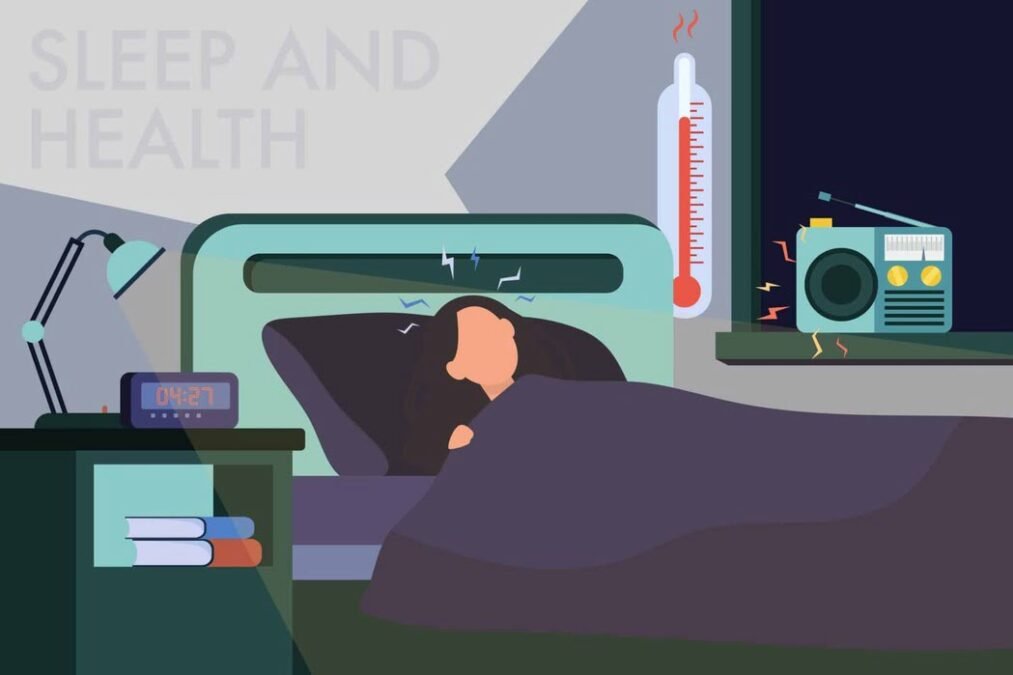
Your physical environment plays a surprisingly large role in directing your mental state. A cluttered, uncomfortable room sends subtle signals of chaos to an already overstimulated mind.
The following are indicators of environmental factors that may be keeping you awake
- Temperature: Aim to keep your room temperature between 60–67°F (15–19°C), as cooler temperatures cue the secretion of the body’s inherent signals of tiredness.
- Lighting: Completely block out all incoming light by using blackout curtains (or an eye mask). The absence of light helps melatonin release from the pineal gland.
- Noise: use white-noise, pink-noise or sound of water action. Quiet and constant background noise prevent the internal response to abrupt loud sounds.
- Clocks: Remove clock hands from view from the bed. The constant subconscious fear of time flying away is the “mental counter.”
When to Seek Professional Support

Although many people experience some form of OVERTHINKING, an ongoing problem of insomnia caused by racing thoughts can be extremely hard to take in the long run as it drains energy, brings changes in mood, and creates health problems.
If you have been experiencing nighttime anxiety for more than a month and have been practicing good sleep hygiene but are still unable to sleep more than half the week, reach out to your primary care doctor or a qualified mental health professional. Cognitive Behavioral Therapy for Insomnia (CBT-I) can be an evidence-based, highly effective method of retraining what your brain associates with sleep and providing lasting tools for peace.
CONCLUSION:
Eliminating excessive internal noise at night is a gradual process — initial changes and stubborn behaviors to overcome in this area take time to correct, as it’s an absolutely learned skill; it takes consistency and self-compassion. Now, as you flip off your lamp tonight, remember that your mind is not your worst enemy.
It is simply an eager but overprotective friend without clear boundaries and gentle reassurance. When you find yourself, write it down somewhere safe, create a cooler and more comfortable environment for your body to rest in, and order that rest of the world can save itself for the morning.

