




Skin Cycling Can Transform Your Complexion

If you have ever stood in front of your bathroom mirror, overwhelmed by a dozen half-empty bottles of serums, acids, and retinoids, wondering, “Am I doing too much?”—you are certainly not alone. In an era dominated by beauty influencers and skincare trends telling us we need a 10-step routine morning and night, our skin barriers are crying out for help.
Originally popularized by New York-based board-certified dermatologist Dr. Whitney Bowe, skin cycling has taken the beauty world by storm. It’s not just another buzzy TikTok trend; it is a methodical, dermatologist-approved system that brings wisdom back to your skincare routine. With its rotating active ingredients and built-in recovery days, this technique allows you to reap the rewards of potent products without the risk of irritation, redness, or inflammation.
Now, we’re breaking down skin cycling: what it is, how it works, and how you can easily add it into your routine for that elusive healthy glow.
What Is Skin Cycling?

At its core, skin cycling is a structured, four-night rotation routine designed to give your skin active treatment and strategic recovery time. Instead of layering strong actives haphazardly—like slapping a chemical exfoliant and prescription retinol on your face on the same night—you cycle through them methodically.
The classic skin cycling schedule runs on a four-day cycle:
- Night 1: Exfoliation Night
- Night 2: Retinoid Night
- Night 3: Recovery Night
- Night 4: Recovery Night
- And then you repeat
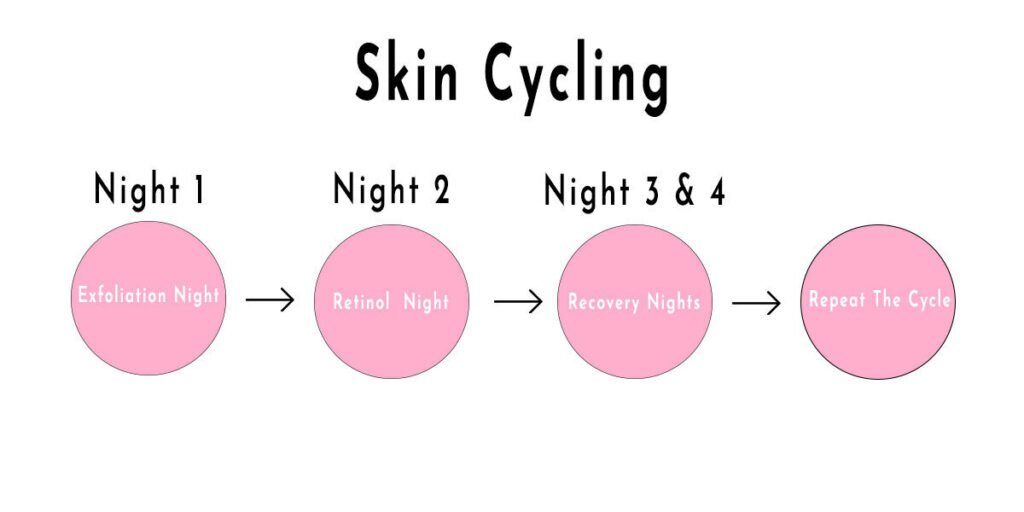
Think of it like physical fitness. You wouldn’t do heavy weight training and intense sprints seven days a week without rest days; your muscles would tear, and you’d burn out. Your skin is no different. Skin cycling gives your skin cells the same level of consideration, alternating the use of high-performance actives with necessary rest time for the skin to mend its barrier.
Why Your Skin Barrier Needs a Break
Before skin cycling, the prevailing mindset in skincare was often “more is more.” If a little bit of acid makes your skin smooth, surely soaking your face in it twice a day will make it glass-like, right? Wrong.
Over-exfoliation and the aggressive overuse of active ingredients damage the stratum corneum—the outermost layer of your skin. When this barrier is compromised, tiny microscopic cracks form, allowing moisture to escape and irritants to enter. The result? Chronic redness, flaking, stinging when you apply a gentle moisturizer, and ironically, more breakouts.
Skin cycling stops this vicious cycle. By incorporating two consecutive recovery nights, you give your skin cells time to regenerate, lock in hydration, and reinforce their natural lipid barrier.
The 4-Night Breakdown: Step-by-Step
To get the most out of your routine, it helps to understand what happens on each specific night of the cycle. Here is the exact blueprint to follow:
Night 1: Exfoliation Night (Reset)
The purpose of the first night is to exfoliate your skin, so you can sweep away dead skin cells, unclog pores, and prep your skin to soak in other products. You have to be sure to use products that not only exfoliate in-depth, but also effectively offer your skin a second chance to breathe.

- What to use: A chemical exfoliant (a leave-on serum or a liquid exfoliant) with AHAs (like glycolic or lactic acid) or BHAs (like salicylic acid). Avoid abrasive physical scrubs with sharp particles, which could cause micro-tears in the skin.
- How to do it: Once you have cleansed your face and dried it, apply your exfoliant with your fingers or a cotton pad. Then, follow up with a rich moisturizer to soften the skin and ward off further drying.
Night 2: Retinoid Night (Renewal)

Retinoids (including retinol, retinaldehyde, or the prescription tretinoin) are considered the gold standard for both anti-aging and acne treatments. They increase cell turnover, promote collagen production, and reduce fine lines. But if you overuse them, they can turn out to be very irritating.
- What to use: Your choice of retinoid cream or serum.
- How to do it: Apply just a pea- sized amount of your favored retinoid on your clean and dry skin. If you have sensitive skin, you can practice the “sandwich method”—apply a light layer of moisturizer, let it dry, apply your retinoid, and top it off with another layer of moisturizer. This buffers the strength slightly without killing the efficacy.
Nights 3 and 4: Recovery Nights (Repair)p
These are arguably the most important nights of the cycle, yet they are the ones people are most tempted to skip.
- What to use: Hydrating, soothing, and barrier-repairing ingredients. Look for products containing ceramides, hyaluronic acid, niacinamide, glycerin, and peptides. Leave the active acids and retinols locked away in your cabinet.
- How to do it: Cleanse your face, and while your skin is still slightly damp, apply a hydrating serum followed by a rich, comforting moisturizer. Plump, calm, and deeply nourished is how your skin wakes up after drinking this in.
The Perks: Why Skin Cycling Works Greatly

Dermatologists and beauty editors are obsessed with this technique for a reason. The benefits are visible and cumulative.
Less Irritation: Separating your retinoids and exfoliants means less irritation and flaking when you start using powerful actives.
Enhanced Efficacy: When your skin barrier is healthy and undamaged, it absorbs products far more efficiently. The results of using actives less frequently are far better than using them daily and burning your skin.
Simplified Decision: No more guessing what to put on your face every evening. You look at your calendar, check what night of the cycle you are on, and apply accordingly.
Cost-Effective: Because you are using fewer products simultaneously and giving your skin what it actually needs, you stop wasting money on redundant serums that clash with each other.
Customizing Skin Cycling for Your Skin Type
One of the greatest beauties of skin cycling is its extreme versatility. It is not a rigid one-size-fits-all prison; it is a framework that you can tweak based on how your skin responds.
For Sensitive or Rosacea-Prone Skin:
If your skin flushes easily or reacts poorly to strong products, you may want to modify the rhythm. Instead of two recovery nights, try three recovery nights (Night 1: Exfoliate, Night 2: Retinoid, Nights 3, 4, & 5: Recovery). Listen to your skin and slow down the tempo.
For Oily and Acne-Prone Skin:
Acne-prone skin often handles retinoids and BHAs very well. Once your skin adjusts to the standard 4-night cycle, you might choose to swap one of the recovery nights for a targeted spot-treatment night or a gentle BHA night, though keeping at least two recovery nights is still recommended to protect the skin barrier from micro-tears.
For Dry or Mature Skin:
Focus heavily on rich, emollient moisturizers during your recovery nights. You can even practice “slugging” (applying a thin layer of an occlusive ointment like petrolatum over your moisturizer) on Night 4 to lock in ultimate hydration overnight.
Common Pitfalls to Avoid
While skin cycling is relatively foolproof, beginners sometimes make a few common mistakes:
- Mixing Active Families: Do not use Vitamin C serums or other direct acids on your exfoliation or retinoid nights unless explicitly formulated together. Keep mornings for Vitamin C and antioxidants, and reserve evenings for the core routine.
- Forgetting Sunscreen: Exfoliants and retinoids make your skin significantly more sensitive to UV radiation. Wearing a broad-spectrum sunscreen with SPF 30 or higher every single morning is non-negotiable if you want to see real results from your evening cycle.
- Ignoring Skin Signals: If your skin feels tight, stings when you apply a basic moisturizer, or looks raw, your skin needs an extended break. Pause the cycle and do 3 to 4 nights of pure recovery hydration until your skin returns to normal.
Final Thoughts: Consistency Over Intensity

In skincare, as in life, consistency always beats intensity. Pushing your skin to the absolute brink with aggressive daily treatments rarely leads to healthy, glowing skin. Instead, it leads to inflammation, barrier damage frustration, and a shelf full of abandoned products.
Skin cycling offers a balanced, mindful approach that respects your skin’s natural biology. By alternating high-powered treatments with dedicated rest and repair, you allow your skin to look its absolute best—radiant, resilient, and glowing from within.
Are you ready to give skin cycling a try, or have you already incorporated a version of it into your routine?

